
14 KiB

Trainlog is a local-first system for recording, synchronizing, and examining training and body data. Its Android companion handles capture in the field; the C17 desktop core keeps the canonical long-term history; a keyboard-first Notcurses TUI and a loopback-only Web application provide complementary ways to inspect and manage it.
The system is built around explicit facts, stable identities, versioned JSON exchanges, and user-controlled storage. Plans never become performed work until they are actually recorded, continuous activities are not disguised as sets, and estimates are kept distinct from measurements.
Release line: The latest stable release is
v0.1.6.
✦ Showcase
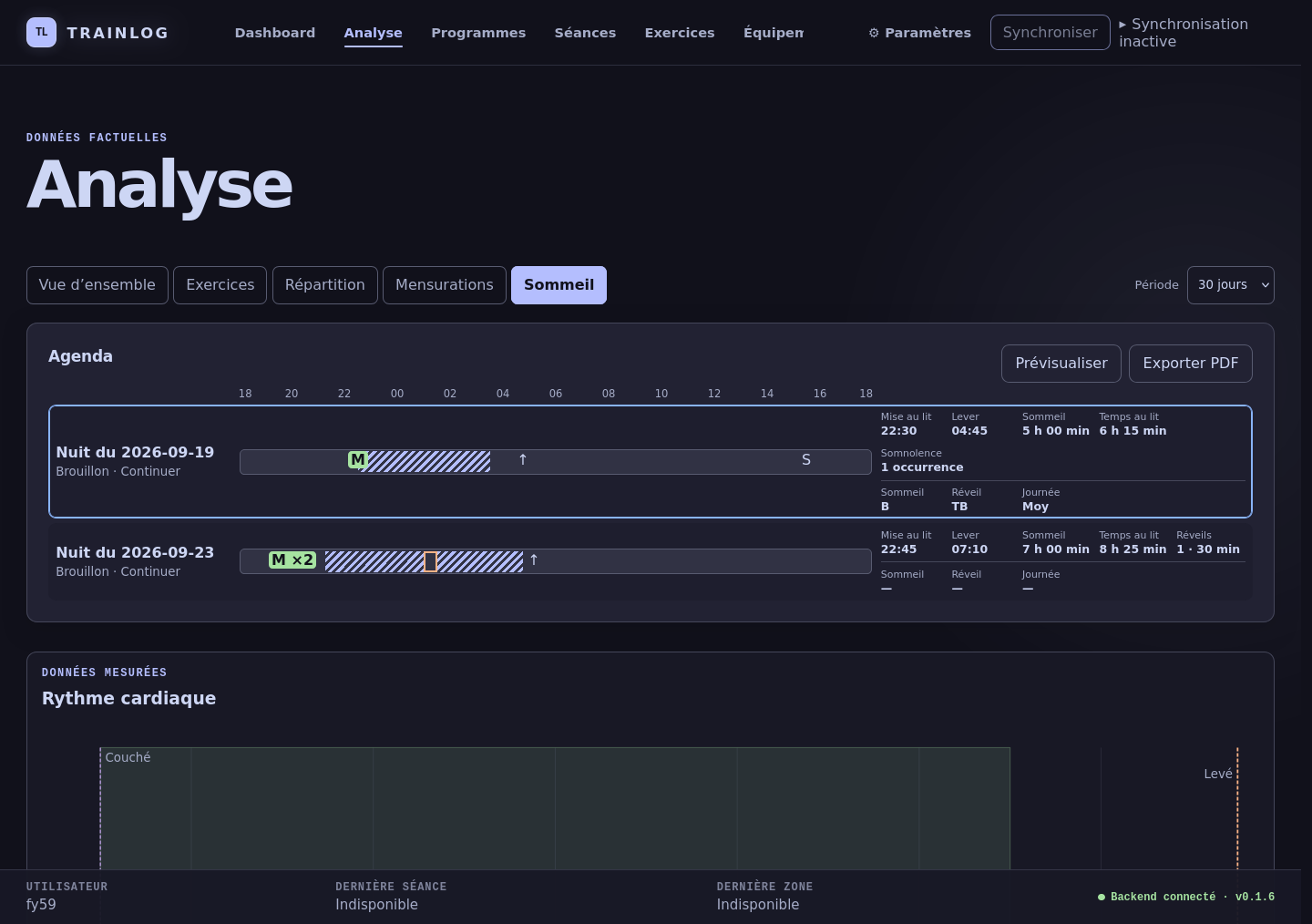
Web Analyse in Trainlog 0.1.6 — synchronized Sleep facts and measured heart-rate data on one timeline.
The repository currently tracks real-browser evidence for the Web interface. Its Android overview asset is a clearly labelled static design study with fictional data, not a runtime screenshot; no current TUI screenshot is tracked. Those assets are therefore not presented here as product captures.
✦ Features
| Area | Available in the current development tree |
|---|---|
| Training capture | Metadata-driven sets, repetitions, durations and continuous activities; heterogeneous actual sets; durable active draft; exercise timelines; explicit measured MAX results. |
| Planning | Manual preparations, imported Programs, Android delivery, execution provenance and strict separation between targets and facts. |
| Context | Exercise and equipment catalogues, BODY ZONES, body measurements, immediate feedback, wording revisions and J+1 follow-ups. |
| Cardio | Android BLE heart-rate acquisition, factual BPM/RR history, cardio sessions, measured calibration and fresh-signal phase guidance. |
| Sleep | One-tap Android capture, causal Sleep Diary revisions, medication occurrences, synchronized factual timelines and local vector PDF export. |
| Desktop | C17 Core, canonical SQLite history, keyboard-first Notcurses administration, correction, statistics, graphs and synchronization diagnostics. |
| Local Web | Loopback-only Dashboard, Analyse, Programmes, Sessions, Exercises, Equipment, Settings and synchronization surfaces backed by typed Core services. |
| Synchronization | One generation/ACK business engine over authenticated Bluetooth Classic RFCOMM, direct USB/MTP recovery and a separately configured private Drive workflow; SQLite files are never exchanged. |
Boundaries and work in progress
TRAINLOG_FORMAT_V1remains frozen. The active mobile snapshot is V3; V1 and V2 remain readable, while V4 codecs are staged but not selected by the active transport.- Full-generation synchronization is deployed only behind a trusted local opt-in; the default automatic exchange remains V3.
- AI history export is active. AI session proposals still have a pending real Drive plus Android-triggered bidirectional smoke test.
- Session Generator V1 is implemented but hidden while the V2 planning model is developed.
- Web Analyse is implemented; its recorded visual-review gate remains open.
The canonical status and limitations live in
docs/current_state.md; future work belongs in the
roadmap.
✦ Architecture
┌──────────────────────────────┐
│ Android field companion      │
│ private SQLite capture store │
└──────────────┬───────────────┘
               │ versioned JSON generations + acknowledgements
               │ Bluetooth RFCOMM primary · direct USB/MTP recovery
               ▼
┌──────────────────────────────┐       optional, separately configured
│ Synchronization orchestration│◄───── private Drive workflow
└──────────────┬───────────────┘
               │ typed imports, commands and read models
               ▼
┌──────────────────────────────┐
│ Trainlog Core · C17          │
│ desktop SQLite = canonical   │
│ long-term history            │
└──────────────┬───────────────┘
               │
        ┌──────┴──────────┐
        ▼                 ▼
┌──────────────┐   ┌──────────────────────┐
│ Notcurses TUI│   │ 127.0.0.1 Web adapter│──► browser
└──────────────┘   └──────────────────────┘
The TUI, Web application, and Android client are sibling adapters with
different responsibilities. Business rules, calculations, persistence, and
typed read models belong to Core; presentation code does not reconstruct them
from raw database tables. See the full
architecture contract.
✦ Your data, your system
- Trainlog runs on the user's own Android and Linux systems; no hosted Trainlog account or proprietary cloud service is required for core capture, history, analytics, or direct synchronization.
- Android and desktop each keep a local SQLite database; the desktop database is the canonical long-term history.
- Devices exchange bounded, versioned JSON artifacts—not database files.
- The local Web server binds to
127.0.0.1by default and never silently falls back to a LAN address or another port. - Direct Android storage uses
Documents/Trainlog; desktop USB access useslibudevandlibmtpwithout requiring a GVFS/FUSE mount. - The optional Drive path is operator-configured through external
rclone. Android holds no cloud credentials.
✦ Build and run
Desktop and TUI
The desktop build requires Meson, Ninja, a C17 toolchain, pkg-config, Python
3, and development files for SQLite, libuuid, utf8proc, libudev, libmtp,
Notcurses Core, GNU libmicrohttpd, and yyjson.
meson setup build
meson compile -C build
meson test -C build --print-errorlogs
./build/tui/trainlog
The desktop database is stored at
$XDG_DATA_HOME/trainlog/trainlog.db, or
~/.local/share/trainlog/trainlog.db when XDG_DATA_HOME is unset.
Embedded local Web application
Node and npm are build-time dependencies only. Meson does not download npm packages.
cd web
npm ci
npm run typecheck
npm test
cd ..

meson setup build-web -Dweb=enabled
meson compile -C build-web
./build-web/tui/trainlog --web
The Web application listens on 127.0.0.1:8080 by default. Use
--port <port> for an explicit alternative. For an existing build directory,
use meson configure build -Dweb=enabled instead of running meson setup
again.
Android
Android builds use the committed Gradle wrapper, JDK 17, and an Android SDK for
the configured API levels (minSdk 26, targetSdk 36, compileSdk 37).
cd android
JAVA_HOME=/usr/lib/jvm/java-17-openjdk ./gradlew test
JAVA_HOME=/usr/lib/jvm/java-17-openjdk ./gradlew assembleDebug
Instrumented tests belong on an emulator; the primary personal phone is reserved for manual, non-destructive installation and synchronization checks. Release APK signing is intentionally operator-local and is not configured with credentials from this repository.
Optional user-session services
After a desktop build, the repository provides an installer for the private automatic synchronization services:
bash tools/install_syncd_user.sh
systemctl --user is-active trainlog-syncd.service
This modifies the current user's ~/.local/bin and systemd user configuration.
Bluetooth generation transport starts only when its separate Trainlog
configuration explicitly enables it. The loopback Web development unit in
systemd/trainlog-web.service is another optional integration; neither service
is required for manual TUI use.
Prebuilt stable APKs and Linux x86-64 runtime bundles are published on both
official mirrors: Forgejo Releases
and GitHub Releases. Verify
downloaded artifacts against the accompanying SHA256SUMS.
✦ Repository layout
trainlog/
├── android/          Kotlin + Jetpack Compose field companion
├── tui/              C17 Core, Notcurses TUI, Web adapter and native tests
├── web/              React + TypeScript + Vite frontend
├── catalog/          versioned scientific and product knowledge
├── format/           JSON schemas and frozen format material
├── contracts/        machine-readable presentation contracts
├── tools/            validators, import/export and sync utilities
├── tests/            cross-surface and protocol regression tests
├── systemd/          optional user-session integration
└── docs/             canonical documentation and review evidence
✦ Documentation
| Start here | Scope |
|---|---|
docs/current_state.md |
Implemented capabilities, versions, validation evidence and active limitations. |
docs/architecture.md |
Component, storage, process, transport and ownership boundaries. |
docs/roadmap.md |
Current cursor and future work. |
docs/android.md |
Android capture, persistence and synchronization behavior. |
docs/tui.md |
Notcurses workflows, correction, analytics and technical tools. |
docs/sync_exchange.md |
Active synchronization flow, replay and acknowledgement semantics. |
docs/exchange_format.md |
Frozen and separately versioned JSON contracts. |
docs/exercise_data_model.md |
Exercise, occurrence, planning, load and MAX semantics. |
docs/database.md |
Desktop SQLite schema and migration contracts. |
docs/tests.md |
Canonical validation commands and coverage strategy. |
The complete ownership map is in docs/README.md, with
chronological detail in the CHANGELOG.
✦ Project status
| Boundary | Current state |
|---|---|
| Product | 0.1.7 bugfix-only development; latest stable release v0.1.6 |
| Desktop persistence | SQLite schema v36 |
| Android persistence | SQLite schema v33 |
| Mobile exchange | V3 active; V1/V2 readable; V4 staged only |
| Desktop terminal | C17 + Notcurses, active backend |
| Local Web | Dashboard and operational Analyse, Programmes, Sessions, Exercises, Equipment, Settings and sync surfaces |
| Interface language | French by default; English selectable on Android and desktop |
| Compatibility | TRAINLOG_FORMAT_V1=PASS/FROZEN |
Forgejo is the primary repository; GitHub is its release mirror. Trainlog is licensed under the GNU General Public License v3.